
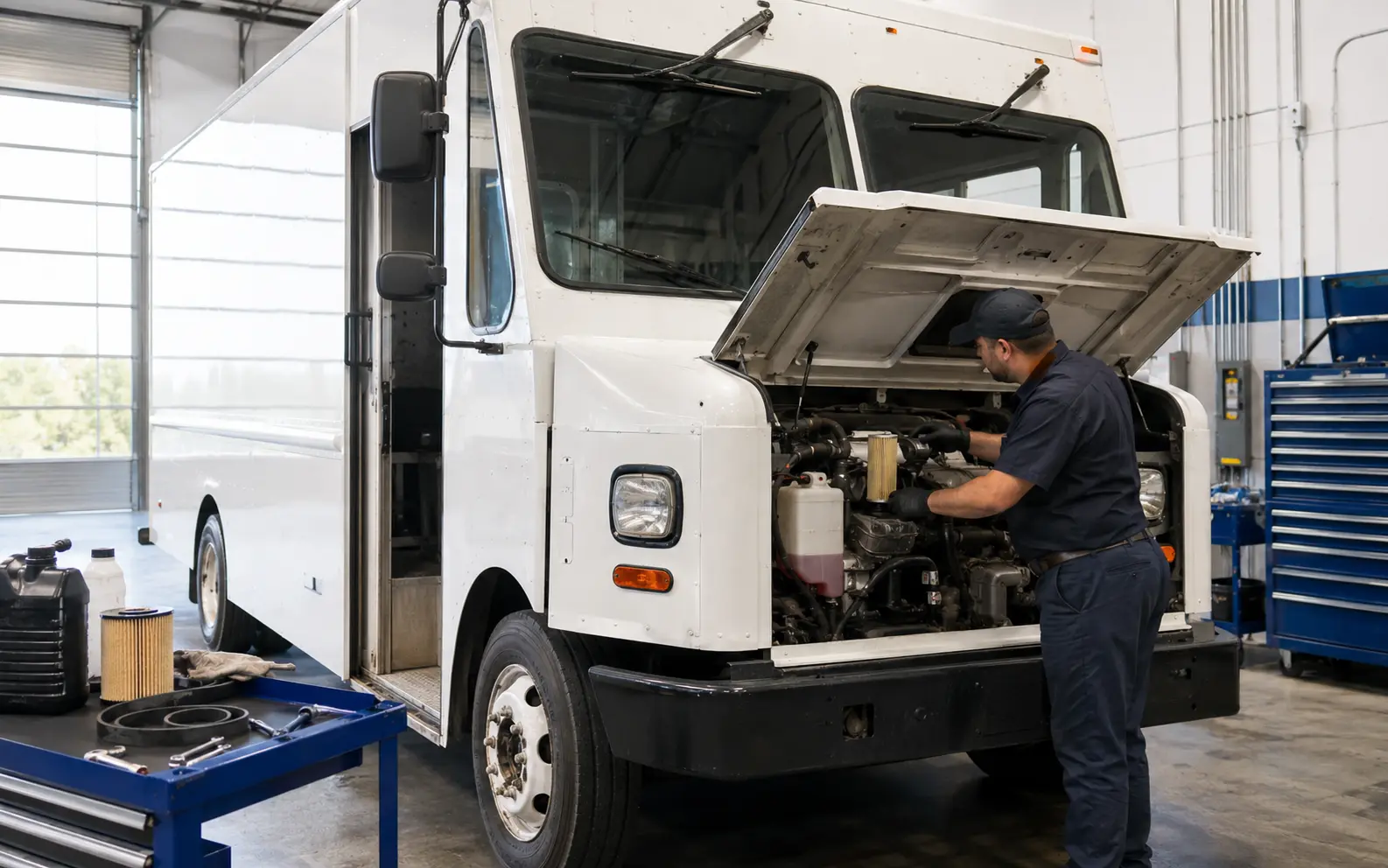
Step vans operate under conditions that can be harder on a vehicle than highway mileage suggests. A delivery truck may travel a relatively short distance while experiencing hundreds of stops, prolonged idling, constant door use, repeated acceleration, tight turns, and continual driver entry and exit.
A maintenance program based only on mileage can miss this wear. High-utilization delivery fleets should combine mileage, time, engine hours, driver inspections, route conditions, and repair history to determine when service is required.
This framework helps fleet operators organize recurring inspections and maintenance. It does not replace the vehicle manufacturer’s maintenance schedule, component specifications, federal or state requirements, or evaluation by a qualified technician.
Why Step Vans Require a Severe-Duty Maintenance Strategy
Delivery operations commonly expose vehicles to:
- Frequent starts and stops
- Extended idle time
- Short trips
- Repeated brake applications
- Low-speed operation
- Tight turning
- Potholes and curbs
- High electrical demand
- Frequent door cycles
- Uneven cargo loading
- Seasonal overload pressure
- Dust, salt, moisture, and road debris
- Limited warm-up and cool-down periods
These conditions can accelerate wear on brakes, steering, suspension, batteries, starters, charging systems, cooling systems, doors, steps, and tires.
If the manufacturer provides a severe-duty schedule, a delivery fleet should generally evaluate the vehicle under that schedule instead of defaulting to normal-service intervals.
Build the Checklist Around Five Maintenance Triggers
A strong step-van preventive maintenance program uses more than a calendar.
1. Mileage
Mileage remains useful for oil changes, lubrication, filters, fluid service, and component inspections.
2. Time
Vehicles that accumulate low mileage still experience corrosion, fluid deterioration, battery discharge, rubber aging, and inspection deadlines.
3. Engine Hours
Idling and low-speed operation may add relatively few odometer miles while the engine, cooling system, charging system, and emissions equipment remain active.
4. Fuel Consumption
Fuel usage can help identify workload and may expose declining efficiency before a mechanical failure occurs.
5. Vehicle Condition
Driver reports, diagnostic alerts, fluid usage, tire wear, and repair history should accelerate maintenance when the vehicle shows signs of deterioration.
A truck should not wait for its next scheduled service when a safety defect or developing mechanical problem has already been identified.
Suggested Maintenance Cadence
This table is a planning framework—not a universal manufacturer schedule.
| Frequency | Recommended review |
|---|---|
| Before and during operation | Driver safety and condition inspection |
| After operation | Defect reporting and route-related observations |
| Weekly | Tires, fluids, lights, doors, body hardware, emergency equipment |
| At each scheduled PM | Full mechanical and safety review |
| Mileage-, time-, or hour-based | Oil, filters, fluids, lubrication, and component service |
| Seasonally | Cooling, HVAC, batteries, tires, corrosion, weather preparation |
| Before peak volume | Brakes, tires, starting systems, spare vehicles, overdue repairs |
| At least every 12 months | Applicable federal periodic inspection |
| After a collision or major repair | Targeted structural, mechanical, and safety inspection |
| After repeated defects | Root-cause diagnosis and management review |
The shortest applicable interval should control. If the mileage interval has not arrived but the time or engine-hour limit has, the service is due.
Common Preventive Maintenance Failures
Maintaining Only by Mileage
This ignores engine hours, time, idling, stop count, and severe-duty operation.
Treating Driver Reports as Complaints
Driver observations are early-warning data. Ignoring them turns minor defects into breakdowns.
Replacing Parts Without Finding the Cause
Repeated batteries, tires, sensors, or brakes may indicate a deeper electrical, alignment, wiring, or operating problem.
Failing to Record Measurements
Without brake, tire, fluid, and battery data, fleets cannot forecast maintenance accurately.
Deferring Body Repairs
Broken steps, doors, shelves, and latches can make an otherwise functional vehicle unsafe or unusable.
Maintaining Spare Vehicles Last
A spare vehicle must be inspected, serviced, registered, and ready to dispatch. Otherwise, it is not productive fleet capacity.
Clearing Warning Lights Without Diagnosis
Deleting a code does not correct the condition that caused it.
Frequently Asked Questions
How often should a step van receive preventive maintenance?
Follow the chassis, engine, body, and component manufacturers’ requirements while accounting for time, mileage, engine hours, and severe-duty delivery conditions. The shortest applicable interval should generally control.
Is delivery driving considered severe-duty operation?
It frequently meets characteristics associated with severe service, including repeated stops, short trips, prolonged idling, heavy electrical use, low-speed operation, and high door-cycle counts. Confirm the applicable definition in the vehicle manufacturer’s maintenance information.
Should preventive maintenance be based on mileage or engine hours?
High-utilization fleets should evaluate both. Engine hours can reveal substantial use that the odometer does not capture, particularly when trucks idle or operate at low speed.
What step-van components are most frequently overlooked?
Doors, steps, grab handles, shelving, cargo restraints, roof leaks, electrical accessories, battery connections, and emergency equipment are commonly neglected.
Can mobile service perform step-van preventive maintenance?
Many inspections and scheduled maintenance services can potentially be completed onsite. The suitability of mobile service depends on the repair, vehicle, location, weather, tools, parts, and safety conditions.
Does preventive maintenance replace the federal annual inspection?
No. Preventive maintenance supports vehicle condition, but covered commercial motor vehicles must still satisfy applicable periodic-inspection requirements.