
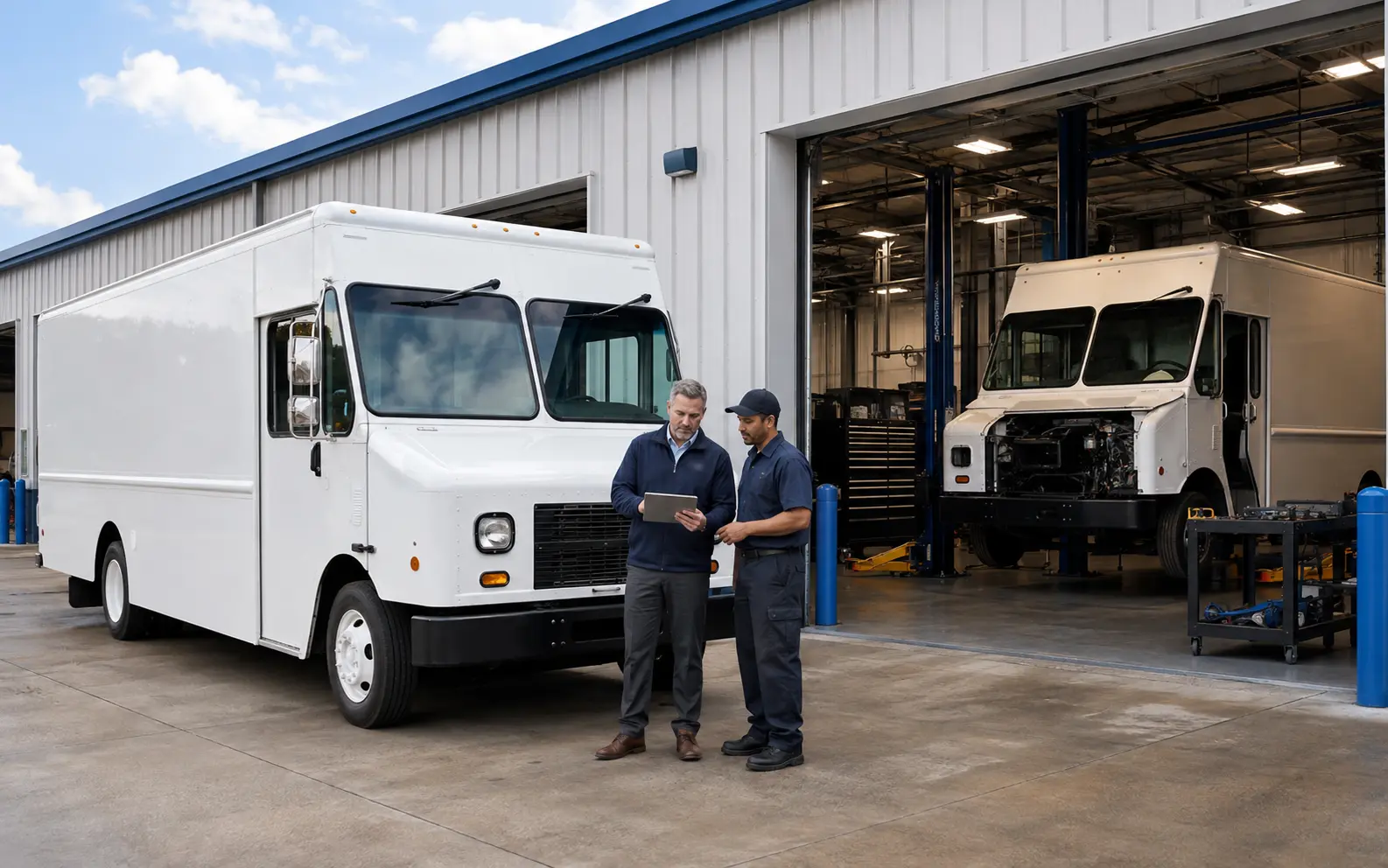
A truck that will be down for several days is no longer only a repair problem. It is a capacity problem. The contractor must decide how to cover the route, how quickly replacement equipment can be made ready, and whether waiting for the repair is actually cheaper than activating another vehicle.
The best response is usually a timed decision rather than an automatic rental. Confirm the repair path, calculate the route exposure, test owned-spare options, and activate a suitable replacement before the operation reaches its failure point.
Sigma Fleet Services provides commercial delivery vehicles that may be suitable for parcel-delivery work, subject to availability, location, insurance, driver documentation, vehicle eligibility, and final rental approval. Sigma is independent and is not affiliated with or endorsed by FedEx Corporation.
Treat an Extended Repair as a Capacity Event
A repair becomes operationally significant when its expected completion date extends beyond the fleet's ability to absorb the loss. The threshold is not always a fixed number of days. A one-day failure can be critical in a fleet with no spare units, while a week-long repair may be manageable when another properly sized vehicle is already staged and ready.
Start with four facts: the disabled unit's route assignment, the earliest credible return-to-service date, the number of route-ready spare vehicles in that market, and the time required to activate a rental. Do not use the shop's best-case estimate as the only plan. Diagnosis can change, parts can be delayed, and additional defects can appear after disassembly.
The decision window ends before the route fails. If insurance documentation, driver approval, vehicle delivery, and a handoff inspection require two business days, waiting until the morning the spare fleet is exhausted is already too late.
For a broader uptime framework, review Reducing Delivery Fleet Downtime and Measuring Fleet Downtime and Repair Cycle Time.
Choose the Right Capacity Response
| Option | Best use | Primary advantage | Main risk |
|---|---|---|---|
| Repair acceleration | The scope is known, parts are available, and completion is dependable | Avoids adding another unit | Expedite cost may not change the true completion date |
| Route reassignment | Nearby routes have real unused capacity and compatible operating conditions | Fast and low direct cost | Overloads vehicles, drivers, or service windows |
| Owned spare deployment | A reliable, correctly sized, documented spare is already in market | Immediate control without a new rental | The fleet loses protection against the next failure |
| Rental replacement | Repair duration exceeds the fleet's reserve or route exposure is material | Restores capacity for a defined period | Requires lead time, qualification, logistics, and active cost control |
Mobile service is appropriate when the vehicle can be repaired safely at its location and the work does not require shop-only equipment. Major disassembly, lift-dependent work, extensive diagnostics, structural repair, or repairs that cannot be completed safely in the field belong in a qualified facility. Use Mobile Fleet Service vs. Shop Service to route the repair itself.
Do not keep moving a disabled vehicle between providers without a clear diagnostic purpose. Every transfer adds towing, handling, approval time, and uncertainty while doing nothing to restore the route.
Estimate the Cost of Leaving the Route Uncovered
Use contribution and disruption cost, not gross route revenue alone. Gross revenue exaggerates the loss if some work can be redistributed, while repair cost alone ignores the operational damage created by an unavailable vehicle.
Include only costs that change because the truck is unavailable. If a driver is paid regardless, do not count the full wage twice. If the route can be absorbed without overtime or service loss, the true exposure may be limited. If the absence forces route splitting, extra miles, late dispatch, or a rejected assignment, the exposure is higher.
Document a reasonable low, expected, and high repair-duration case. A five-day repair with a meaningful chance of becoming ten days should not be evaluated as a guaranteed five-day event. The uncertainty itself has value because temporary capacity protects the operation from the longer case.
The companion Rental Cost vs. Route Downtime decision model provides a full break-even calculation.
Confirm the Replacement Vehicle Fits the Work
A replacement truck must do more than start and move. It must fit the route, cargo profile, driver, operating area, and applicable contractual requirements. A smaller truck can create reloads or route failures; an oversized truck can create clearance, access, turning, parking, or driver-familiarity problems.
Confirm before committing:
- Practical cargo volume for the route, not only advertised cubic capacity
- Payload after accounting for shelving, equipment, driver, fuel, and carried freight
- Overall height, length, turning characteristics, step height, and rear-door configuration
- Powertrain suitability for daily mileage, stop count, grade, weather, and idle time
- Driver license class, experience, authorization, and vehicle familiarization
- Insurance coverage, certificate wording, deductibles, and any required interests
- Inspection status, registration, condition documentation, and required safety equipment
- Pickup location, delivery logistics, fuel level, mileage, keys, and handoff timing
Compare the Sigma step-van rental lineup and the P900 vehicle class as starting points, then confirm the actual assigned unit. Vehicle category names are planning shorthand; the specific unit controls.
Use a Replacement-Vehicle Activation Workflow
Phase 1: Stabilize the repair
Record the unit, defect, location, safe-operating status, repair provider, diagnosis milestone, approval owner, parts status, and earliest credible completion date. Require a defined next update rather than accepting 'we are working on it.'
Phase 2: Quantify the gap
Map the disabled unit to its route and market. Identify available owned spares, their mechanical readiness, cargo fit, inspection status, and current assignments. Determine the date and time when internal capacity will no longer cover the work.
Phase 3: Reserve suitable capacity
Submit the vehicle category, quantity, market, start date, expected return date, intended use, operating area, insurance information, authorized drivers, and any special requirements through the commercial rental request. Availability should be confirmed against a specific eligible unit, not assumed from a generic category page.
Phase 4: Activate and document
Complete the agreement, insurance review, driver documentation, payment authorization, pickup or delivery plan, and condition inspection. Photograph all sides, the cab, cargo area, tires, fuel level, mileage, and any preexisting damage before the unit enters service.
Phase 5: Manage to return
Track the repair and rental on the same operating calendar. Set an extension decision date before the rental deadline, and require written acceptance when the vehicle is returned.
Plan Extensions, Substitutions, and Returns Before Pickup
The expected repair date and the rental return date should never be treated as the same certainty. Set the initial rental period from the credible repair range, then establish an internal decision date early enough to request an extension without risking availability.
If the original rental vehicle becomes unavailable or develops a defect, substitution should be controlled. Confirm the substitute's class, condition, documentation, insurance treatment, mileage, and revised handoff record. Do not place an unfamiliar unit into service solely because it is physically present.
Before return, remove company property, clean the cab and cargo area, satisfy the fuel requirement, record final mileage, photograph condition, document any damage, and obtain written confirmation of the return date and time. Verify billing has stopped. The Rental Fleet Deployment, Extension, and Return Checklist provides the complete process.
A disciplined return process is not administrative clutter. It prevents avoidable disputes, continued billing, missing equipment, and uncertainty over when custody ended.
Questions to Ask Before Committing
- Is a specific unit available for the required market and dates?
- What vehicle class, dimensions, payload, and configuration will actually be assigned?
- What insurance documents and driver records must be accepted before release?
- Who is responsible for preventive maintenance, defects, roadside events, towing, and repair authorization?
- What are the pickup, delivery, extension, substitution, and return procedures?
- How are mileage, fuel, condition, damage, tolls, citations, cleaning, and late return handled?
- What happens if the disabled truck returns early—or the repair takes longer than expected?
- What carrier-specific or contractual requirements remain the contractor's responsibility to verify?
The objective is not to find any truck. It is to activate a documented, operationally suitable replacement before route coverage fails, then remove the rental when the temporary need ends.
Operators in Western Pennsylvania can review Pittsburgh fleet support. For multi-market needs or a replacement vehicle, contact Sigma Fleet Services to confirm location, timing, eligibility, and availability.