
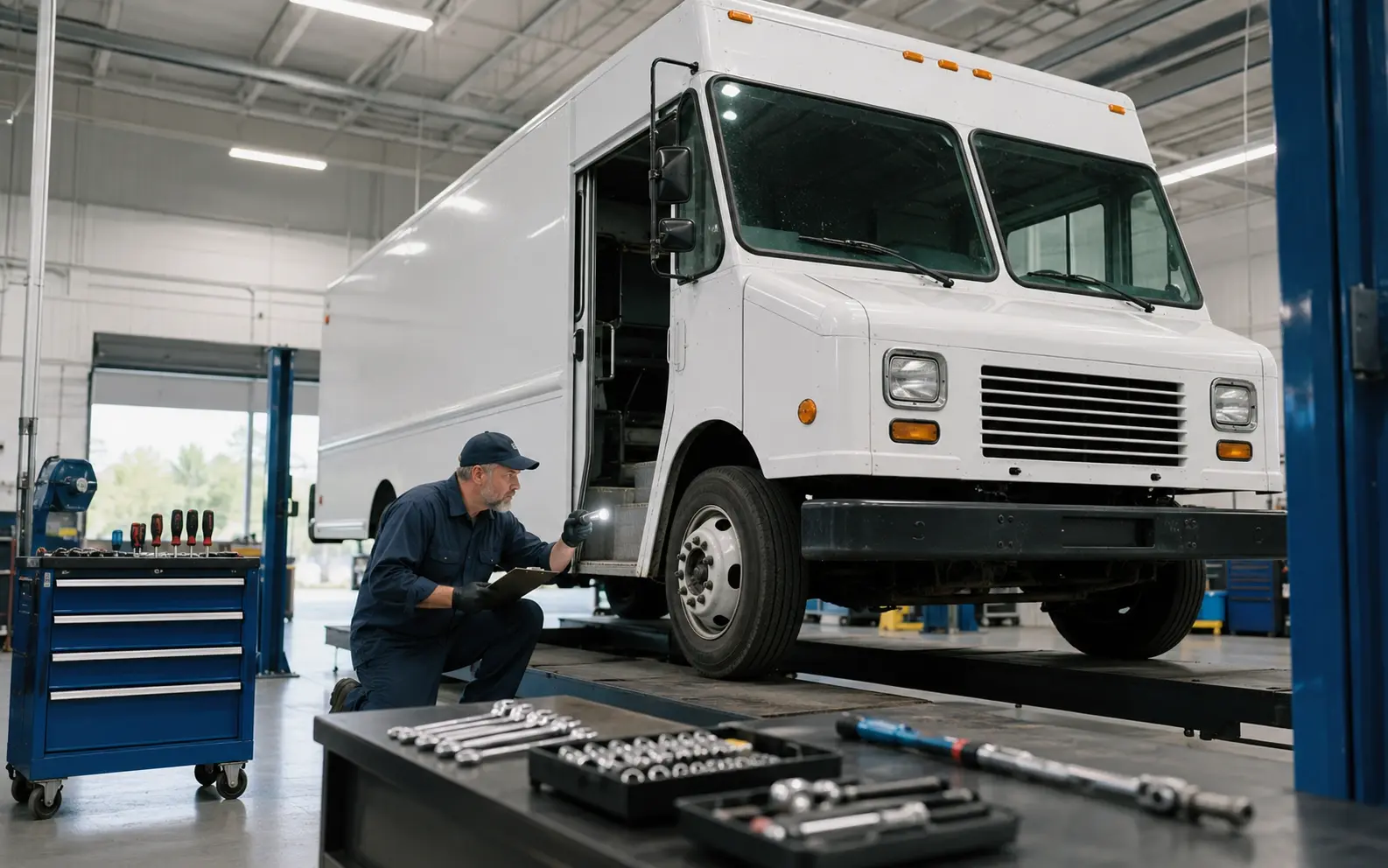
A federal annual inspection should confirm that a commercial motor vehicle meets minimum safety standards—not become the first time the fleet discovers worn brakes, damaged suspension components, lighting failures, or missing maintenance records.
The best preparation begins weeks before the inspection. Fleet operators should verify which vehicles are subject to the federal requirements, review unresolved defects, perform a thorough mechanical assessment, complete necessary repairs, and organize the documentation needed to prove compliance.
Sigma Fleet Services helps commercial fleets prepare for annual inspections through preventive maintenance, vehicle inspections, corrective repairs, documentation review, and mobile fleet service.
What Is the Federal Annual Inspection Requirement?
The Federal Motor Carrier Safety Administration’s periodic-inspection rule appears in 49 CFR § 396.17. It generally requires every covered commercial motor vehicle to pass an inspection at least once during the preceding 12 months.
The inspection must cover, at minimum, the parts and accessories identified in Appendix A to 49 CFR Part 396. A motor carrier must not operate a covered vehicle unless the required components have passed and qualifying inspection documentation is carried on the vehicle. For a combination vehicle, each individual vehicle—including the tractor, trailer, full trailer, and converter dolly when applicable—must be inspected separately. See 49 CFR § 396.17.
Although the regulation is commonly called the “DOT annual inspection,” the federal rule technically requires a periodic inspection within the preceding 12 months.
What Does the Federal Annual Inspection Cover?
Appendix A to Part 396 establishes the federal minimum periodic-inspection standards. The applicable components depend on the vehicle’s configuration and equipment.
Major inspection categories include:
- Brake systems
- Coupling devices, when equipped
- Exhaust systems
- Fuel systems
- Lighting devices
- Safe loading and cargo securement
- Steering mechanisms
- Suspension systems
- Frames
- Tires
- Wheels and rims
- Windshield glazing
- Windshield wipers
- Additional passenger-vehicle or motorcoach components when applicable
The inspection is not limited to confirming that components are physically present. The inspector evaluates whether applicable defects or deficiencies prevent the vehicle from meeting the minimum standards. Review Appendix A to 49 CFR Part 396.
Federal Compliance Is the Minimum
Passing an annual inspection establishes that the inspected components met the applicable minimum standards at that time. It does not prove that the vehicle will remain safe for another 12 months without maintenance.
High-mileage and high-stop delivery vehicles should receive:
- Scheduled preventive maintenance
- Routine brake measurements
- Tire inspections
- Driver defect reviews
- Mileage-based service
- Seasonal preparation
- Immediate investigation of warning lights
- Prompt repair of safety-related defects
A passing annual inspection is one part of a compliant maintenance program—not the entire program.
Frequently Asked Questions
How often is a federal annual inspection required?
A covered commercial motor vehicle must pass the required periodic inspection at least once during the preceding 12 months.
Is the inspection valid until the same date next year?
The federal rule is based on the preceding 12 months. Fleets should track the exact inspection date and schedule the next inspection early enough to complete repairs before the vehicle’s eligibility expires.
Can any mechanic perform a DOT annual inspection?
No. The person performing the inspection must satisfy the qualification requirements in 49 CFR § 396.19. Additional brake-inspector qualifications may also apply.
Does a state inspection sticker satisfy FMCSA requirements?
Not necessarily. It may qualify if the state program has been determined equivalent under § 396.23 and the inspection and documentation meet the applicable requirements. A carrier should verify this rather than assume equivalency.
Does a clean roadside inspection count as the annual inspection?
No. A violation-free roadside inspection does not substitute for the periodic inspection required by § 396.17.
How long must the annual inspection report be retained?
The responsible carrier or entity must retain the original or a copy for 14 months from the inspection-report date.
Must proof of the inspection remain on the truck?
Yes. Qualifying documentation of the most recent inspection must be on the vehicle. It may be the report or a compliant sticker, decal, or other document based on the report.
Can a vehicle operate with a current annual inspection but a new safety defect?
No. A current inspection does not excuse a new unsafe condition. Safety-related defects must be addressed in accordance with the applicable inspection, repair, and maintenance rules.