
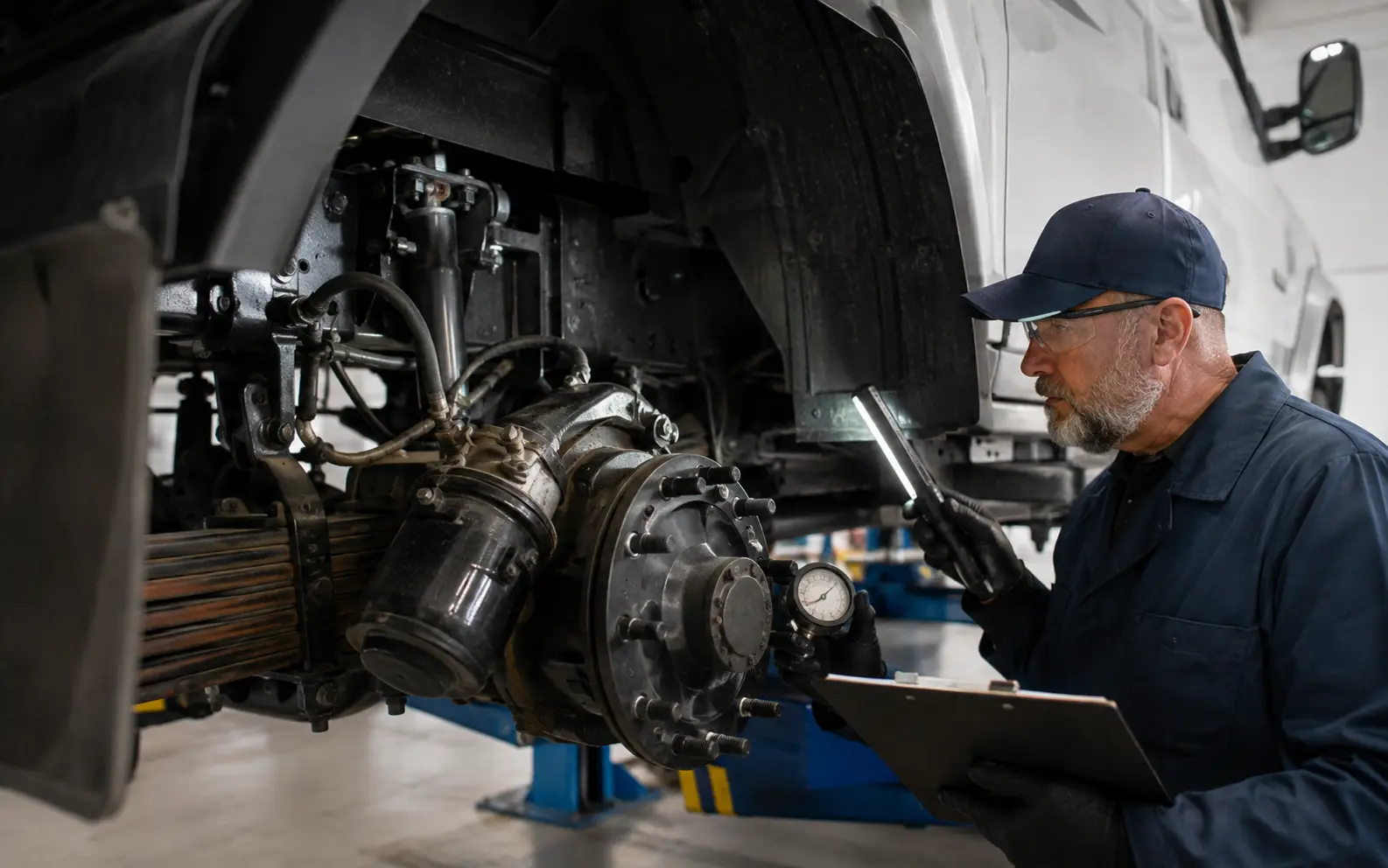
Understand which commercial vehicles may be covered, how interstate commerce can apply, and what federal rules require of qualified annual inspectors.
Which Vehicles Are Generally Covered?
Federal Motor Carrier Safety Regulations generally apply to commercial motor vehicles used in interstate commerce when the vehicle or combination meets the federal definition of a CMV.
That definition generally includes a vehicle used in interstate commerce to transport property or passengers when it:
- Has a GVWR, GCWR, gross vehicle weight, or gross combination weight of at least 10,001 pounds, whichever is greater;
- Is designed or used to transport more than eight passengers, including the driver, for compensation;
- Is designed or used to transport more than 15 passengers, including the driver, without compensation; or
- Transports hazardous materials in a quantity requiring placarding.
The federal inspection threshold is not the same as the CDL threshold. Many delivery step vans and box trucks below 26,001 pounds do not require a CDL but are still commercial motor vehicles subject to Part 396 when operated in covered interstate commerce. FMCSA explains CMV applicability here.
Intrastate fleets may be subject to state inspection requirements or state-adopted versions of the federal rules. Operators should confirm the requirements applicable to their vehicles, operating authority, location, and type of commerce.
Interstate Commerce Can Be Broader Than Crossing State Lines
A vehicle does not necessarily have to cross a state border itself to be involved in interstate commerce.
The underlying movement of the property can matter. Local pickup or delivery activity may be considered part of interstate commerce when the shipment originated outside the state or is continuing to an out-of-state destination.
Delivery contractors should not assume their vehicles are exempt merely because individual routes remain within Pennsylvania, New York, or another single state. Applicability should be evaluated using the complete nature of the transportation.
Who May Perform the Federal Annual Inspection?
The inspection must be performed by a qualified inspector. A person does not become qualified simply because the individual is a mechanic or has previously completed passenger-vehicle inspections.
Under 49 CFR § 396.19, the inspector must:
- Understand the inspection criteria in 49 CFR Part 393 and Appendix A to Part 396;
- Be able to identify defective components;
- Understand the inspection methods, procedures, tools, and equipment; and
- Have qualifying training, experience, or a combination of both.
A person may qualify by completing an appropriate federal- or state-sponsored training program, holding an applicable state or provincial certificate, or possessing at least one year of qualifying inspection or commercial-vehicle maintenance training and experience.
The carrier must retain evidence of the inspector’s qualifications for as long as that person performs annual inspections for the carrier and for one year afterward. An exception applies to qualification records for inspections conducted through a state periodic-inspection program. See 49 CFR § 396.19.
If brakes are inspected, maintained, serviced, or repaired by carrier personnel, the separate brake-inspector qualification requirements in 49 CFR § 396.25 may also apply.
Can a Carrier Perform Its Own Annual Inspections?
A motor carrier may perform its own federal annual inspections when permitted under the regulations, but the person conducting the inspection must meet the qualification requirements.
A carrier may also use:
- A qualified commercial repair facility
- A fleet maintenance provider
- A qualified truck-service facility
- A fleet leasing company
- Another properly equipped commercial business employing qualified inspectors
The carrier remains responsible for ensuring that the inspection was properly completed and documented. Outsourcing the inspection does not eliminate the carrier’s compliance responsibility.
Does a State Inspection Satisfy the Federal Requirement?
Sometimes—but not automatically.
Under 49 CFR § 396.23, a mandatory state inspection program may satisfy the federal periodic-inspection requirement when FMCSA has determined that the program is equivalent to or as effective as the federal standard. See 49 CFR § 396.23.
A state safety or emissions inspection sticker should not be assumed to satisfy the federal annual inspection requirement. The carrier must confirm that:
| 1. | The applicable state program is recognized as equivalent; |
|---|---|
| 2. | The vehicle passed the correct type of inspection; |
| 3. | The inspection remains valid; and |
| 4. | The required documentation is available. |
State law may also impose requirements in addition to the federal rules.
A Roadside Inspection Is Not an Annual Inspection
A violation-free roadside inspection does not, by itself, satisfy the federal periodic-inspection requirement.
FMCSA removed the former option that allowed certain roadside inspections to serve as the annual inspection. A CVSA Level I or Level V inspection should therefore not be treated as a substitute for the inspection required by § 396.17.
Roadside inspections and annual inspections serve related but different compliance purposes.