
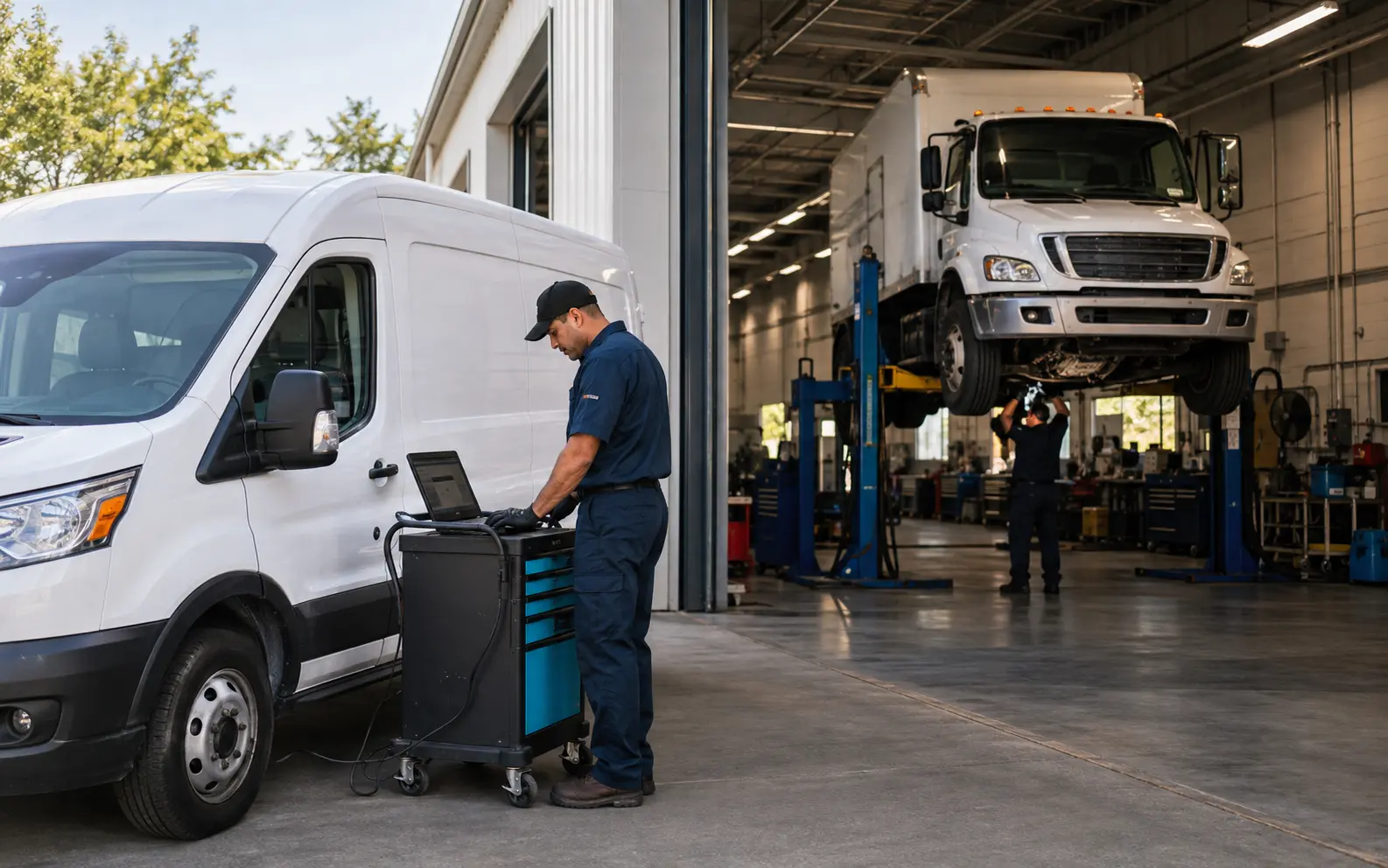
The fastest repair option is not always mobile service, and the most capable option is not always sending a vehicle to a shop.
The correct decision depends on what failed, whether the vehicle can be operated safely, where it is located, what equipment the repair requires, and how each option affects fleet operations.
Mobile fleet service is often ideal for preventive maintenance, inspections, diagnostics, and repairs that can be completed safely onsite. Shop service is generally better for major mechanical work, repairs requiring lifts or specialized equipment, and vehicles that need extensive diagnosis.
Sigma Fleet Services helps commercial operators select the appropriate service model and return delivery vehicles to productive operation as quickly as practical.
Begin with Safety
The first question is not where the vehicle should be repaired. It is whether the vehicle can be safely operated or moved.
Do not drive a vehicle to a repair facility merely to avoid a mobile-service charge or towing expense.
A vehicle may require immediate shutdown, onsite evaluation, or towing when it has:
- A brake-system concern
- Loss of steering control
- Severe tire or wheel damage
- A significant fuel or fluid leak
- Overheating
- Low oil pressure
- Suspension or axle damage
- A major electrical short
- Smoke or evidence of fire
- A driveline failure
- An unsafe door, step, or body component
- An active warning directing the operator to stop
When the condition is uncertain, keep the vehicle parked until a qualified person evaluates it.
Mobile Service and Shop Service Compared
| Factor | Mobile service | Shop service |
|---|---|---|
| Vehicle transportation | Usually unnecessary | Vehicle must be driven or towed |
| Best use | Maintenance, inspection, diagnosis, defined repairs | Complex, equipment-intensive, or major repairs |
| Scheduling | Can often occur during fleet downtime | Depends on facility availability |
| Shop queue exposure | Limited | May be significant |
| Technician equipment | Limited to what can be transported | Broader tools and fixed equipment |
| Environmental control | Depends on location and weather | Indoor and controlled |
| Major disassembly | Usually limited | Better suited |
| Multi-vehicle service | Highly efficient at one location | Vehicles must be transported individually |
| Roadside capability | Potentially available | Not applicable |
| Repair scope changes | May require a second visit or tow | Easier to expand the repair onsite |
Neither model is universally better. The objective is to select the option that produces the shortest safe and complete repair cycle.
A Five-Question Service Decision
Before choosing mobile or shop service, answer:
| 1. | Is the vehicle safe to operate or move? |
|---|---|
| 2. | Can the complete repair be performed safely onsite? |
| 3. | What equipment, parts, and expertise are required? |
| 4. | Which option creates the shortest realistic return-to-service time? |
| 5. | How will the route be covered if the repair is delayed? |
If those questions are answered honestly, the correct service model is usually clear.
Frequently Asked Questions
What repairs can mobile fleet service perform?
Mobile service may handle preventive maintenance, inspections, batteries, lighting, basic diagnostics, minor electrical problems, belts, hoses, and other defined repairs. Capability depends on the vehicle, technician, site, tools, parts, and safety conditions.
When should a commercial truck be taken to a repair shop?
Shop service is usually appropriate when the vehicle requires a lift, specialized testing, major disassembly, alignment, structural work, or significant engine, transmission, suspension, or emissions repair.
Is mobile fleet service more expensive?
The visible hourly rate or service-call charge may be higher, but mobile service can eliminate towing, driver transportation, shop waiting, and lost operating time. The proper comparison is total cost and total downtime.
Can mobile service perform preventive maintenance after hours?
Potentially. Scheduling depends on location, technician availability, site access, lighting, weather, and the scope of work. Planned after-hours maintenance can reduce interference with delivery operations.
Should a disabled vehicle be repaired roadside?
Only when the location is safe and the repair can be performed properly. A vehicle on a narrow shoulder, in traffic, or on unstable ground may need to be moved or towed.
Does Sigma Fleet Services provide replacement delivery trucks?
Sigma Fleet Services offers commercial delivery vehicles and step vans for rent, subject to inventory, location, insurance, eligibility, and final approval.