
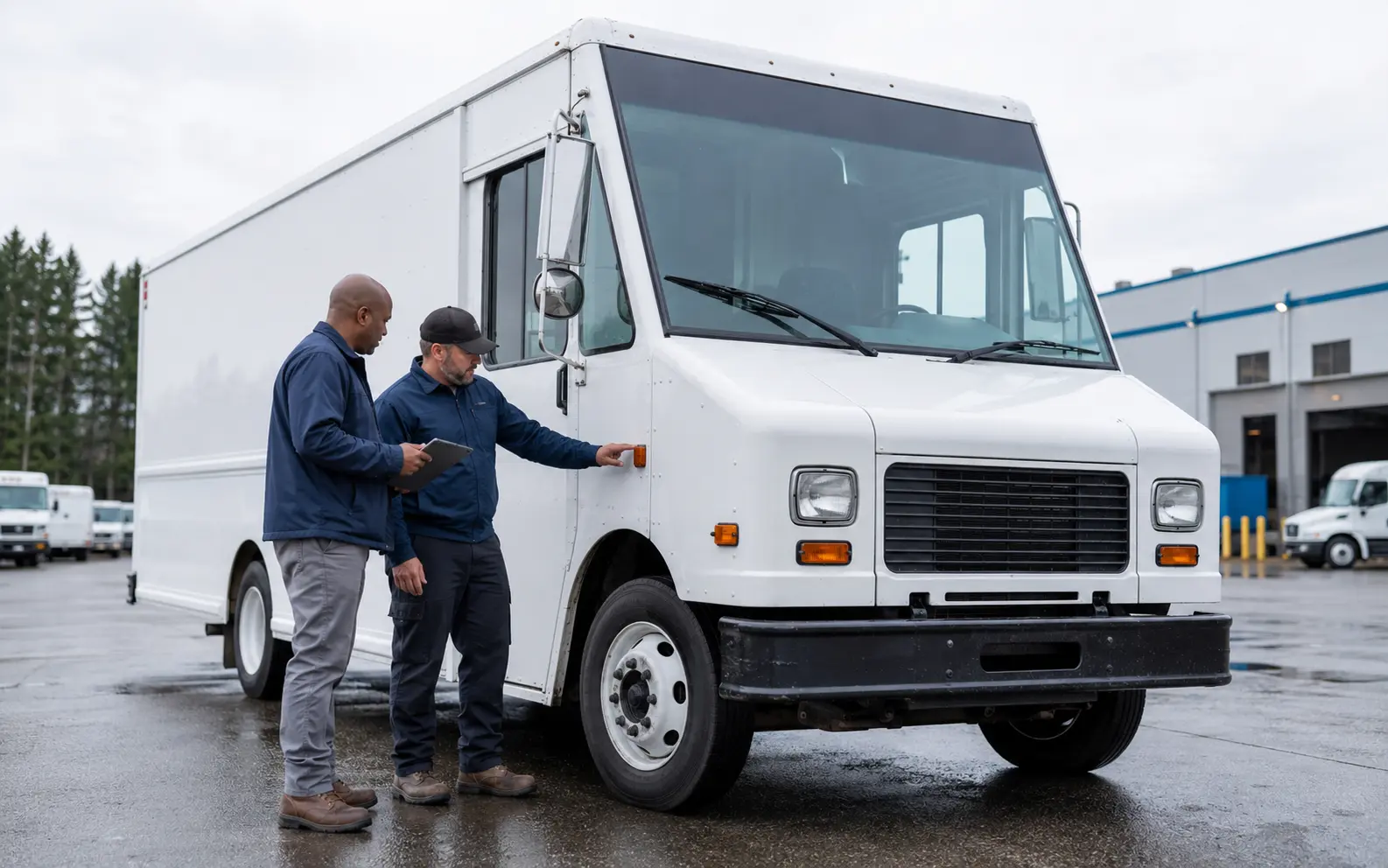
A rental step van is route-ready only when the specific unit, authorized driver, insurance documentation, operating requirements, and handoff records are all accepted. Physical availability by itself is not readiness.
In this guide, 'FedEx-compatible' means a vehicle may be operationally suitable for parcel-delivery work. It does not mean FedEx certifies, approves, or endorses Sigma or a vehicle. The contractor remains responsible for confirming carrier, contractual, safety, branding, insurance, and operating eligibility.
Use this checklist early. A truck discovered today may still require several approvals and logistical steps before it can legally and safely cover a route.
Assign Responsibility at Every Confirmation Stage
| Requirement | Responsible party | Documentation | Confirmation stage |
|---|---|---|---|
| Vehicle category and route fit | Contractor with rental provider | Route profile and unit specifications | Before unit assignment |
| Payload and cargo suitability | Contractor | Expected freight profile and vehicle ratings | Before reservation approval |
| Vehicle condition and inspection | Rental provider and contractor | Inspection and condition report | Before release |
| Insurance coverage | Contractor and insurer | Certificate, endorsements, policy confirmation | Before pickup or delivery |
| Authorized drivers | Contractor | License and required driver records | Before vehicle use |
| Carrier-specific eligibility | Contractor and carrier | Current carrier or contractual requirements | Before route deployment |
| Pickup or delivery logistics | Contractor and rental provider | Confirmed location, time, and recipient | Before handoff |
| Mileage, fuel, and damage baseline | Both parties | Signed report and photographs | At handoff |
| Extension or return | Both parties | Written request or return acceptance | Before contractual deadline |
No single party can complete the entire chain. The rental provider can confirm the unit and its documentation; the contractor controls route requirements, drivers, operating use, and carrier obligations; the insurer controls coverage confirmation. Treat each as a separate gate.
1. Define the Required Vehicle Class
Begin with the work, not a familiar model name. Record the route's peak practical cargo volume, heaviest expected load, number of daily stops, mileage, terrain, road width, parking limitations, loading method, and clearance constraints.
Cargo volume and payload are not interchangeable. Cubic capacity describes space; payload describes weight the vehicle can carry after accounting for the body, installed equipment, fuel, driver, and other load. A high-volume but relatively light parcel route may be limited by space. Dense commercial freight may reach payload limits before the cargo area is full.
Confirm dimensions and configuration for the specific assigned unit. Door type, shelving, bulkhead, steps, camera systems, interior height, wheelbase, and overall height can affect route usefulness even when two vehicles share the same general category.
Use Selecting Rental Vehicles for Delivery Routes and compare P700, P900, P1000, and P1100 step vans. If the route has lower volume or tight access, review the Transit rental category.
2. Confirm Route and Operating-Area Suitability
A suitable vehicle must fit where it will operate. Identify the primary terminal or staging point, counties and states of operation, expected overnight location, toll exposure, parking conditions, and whether the vehicle may cross into another market.
Review:
- Low clearances, restricted roads, narrow streets, loading docks, and gated facilities
- Urban maneuverability, rural mileage, grades, winter conditions, and extended idle time
- Daily start and return locations and whether secure parking is available
- Fuel availability and powertrain familiarity
- Any geographic limits in the rental agreement or insurance coverage
- Whether delivery or pickup timing aligns with dispatch requirements
Do not assume a unit located in one market can be moved to another without approval. Cross-market transfers affect availability, maintenance support, logistics, insurance review, and the return plan.
3. Verify Vehicle Condition and Documentation
Review registration, inspection status, maintenance readiness, open defects, warning lights, tires, brakes, glass, mirrors, lights, doors, steps, seat belts, cargo securement features, fluid leaks, and required emergency equipment. The inspection should match the vehicle and operation; a clean exterior is not evidence of mechanical readiness.
At handoff, record:
- Unit number, VIN, plate, category, and odometer
- Fuel or charge level
- Exterior panels, roof edges, bumpers, glass, mirrors, lights, and tires
- Cab controls, warning indicators, cameras, heater, defroster, and wipers
- Cargo area, bulkhead, shelving, flooring, steps, and rear door
- Keys, fuel card or charging items if applicable, safety equipment, and supplied accessories
- Every preexisting defect or area of damage
Photograph the unit in adequate light before loading or applying approved temporary identifiers. Both parties should retain the condition record.
4. Complete Insurance and Company Verification
Insurance review is often the longest controllable lead-time item. Send the actual rental requirements to the contractor's broker or insurer early. The contractor should confirm applicable liability, physical-damage treatment, deductibles, authorized use, drivers, geographic operation, and any required additional-insured or loss-payee wording.
Do not assume a certificate alone changes coverage. A certificate summarizes information; the underlying policy and accepted endorsements control. Ask the insurer to confirm the requested treatment in writing and resolve inconsistencies before vehicle release.
Company verification may include the legal entity, trade name, physical and billing addresses, authorized signer, operating contact, carrier-related identifiers, payment authorization, and proof that the signer can bind the renter. Submit accurate information through the rental application; discrepancies create delays and can invalidate approvals.
Sigma manually verifies FedEx-related entity information. That verification supports Sigma's rental process; it is not carrier approval.
5. Approve and Prepare Every Driver
A company approval does not automatically authorize every employee to operate the rental. Provide each driver's legal name, license number, issuing state, expiration date, license image, and any other required qualification information. Confirm the license class is appropriate for the specific vehicle and operation.
Before dispatch, familiarize the driver with:
- Vehicle height, length, turning radius, mirrors, cameras, blind areas, and braking feel
- Starting procedure, warning indicators, fuel type, parking brake, lights, wipers, and defroster
- Rear door, steps, bulkhead, cargo securement, and any lift or ramp equipment
- Daily inspection and defect-reporting procedures
- Accident, breakdown, towing, lockout, and roadside-contact procedures
- Restrictions on additional drivers, geographic use, modifications, decals, or equipment
Document vehicle familiarization. A qualified delivery driver may still be unfamiliar with a larger body, different brake response, wider tail swing, or altered overhead clearance.
6. Separate Carrier Requirements from Rental Approval
The contractor must confirm all carrier-specific requirements that affect the vehicle's use. These may involve vehicle type, age, appearance, identifiers, technology, safety equipment, insurance, inspection, driver authorization, or other contractual controls. Requirements can change and may differ by operation.
Sigma cannot approve a vehicle for FedEx. A rental approval means Sigma has accepted the renter and assigned a unit under Sigma's process; it does not override the contractor's agreement with a carrier or any applicable law.
Reconfirm requirements when the operating market, vehicle, driver, insurer, or intended use changes. An approval for one assignment should not be treated as blanket permission for a materially different deployment. Keep the current source, date, and person responsible for each confirmation in the rental file.
Before deployment, obtain answers to three separate questions:
- Will the rental provider release this specific unit to this renter and driver?
- Will the insurer cover this specific use, unit, and driver?
- Does the contractor's current carrier agreement permit this vehicle in the intended operation?
Keep the supporting records with the rental file. Do not rely on a verbal assumption passed from one manager to another.
7. Control Pickup, Deployment, Extension, and Return
Confirm who will receive the unit, where, and at what time. If Sigma delivers the vehicle, the contractor should provide a safe handoff location and an authorized representative. If the contractor picks it up, confirm driver transportation, arrival time, and whether the vehicle can enter service immediately afterward.
Record the route assignment, driver, start date, current mileage, preventive-maintenance responsibility, defect process, expected return, and internal extension decision date. Rental units should be managed inside the same daily inspection and downtime process as owned vehicles.
Extension requests should be made before the deadline and remain subject to availability and approval. For return, inspect and photograph the vehicle, remove company property and approved temporary materials, satisfy fuel and cleaning requirements, record mileage, and obtain written acceptance.
Use the Peak-Season Rental Insurance, Driver, and Vehicle Readiness guide and deployment and return checklist for deeper procedures.
To confirm a vehicle in the Lehigh Valley market, review Northampton fleet support. For current availability and unit eligibility, explore FedEx contractor rental options or contact Sigma.