
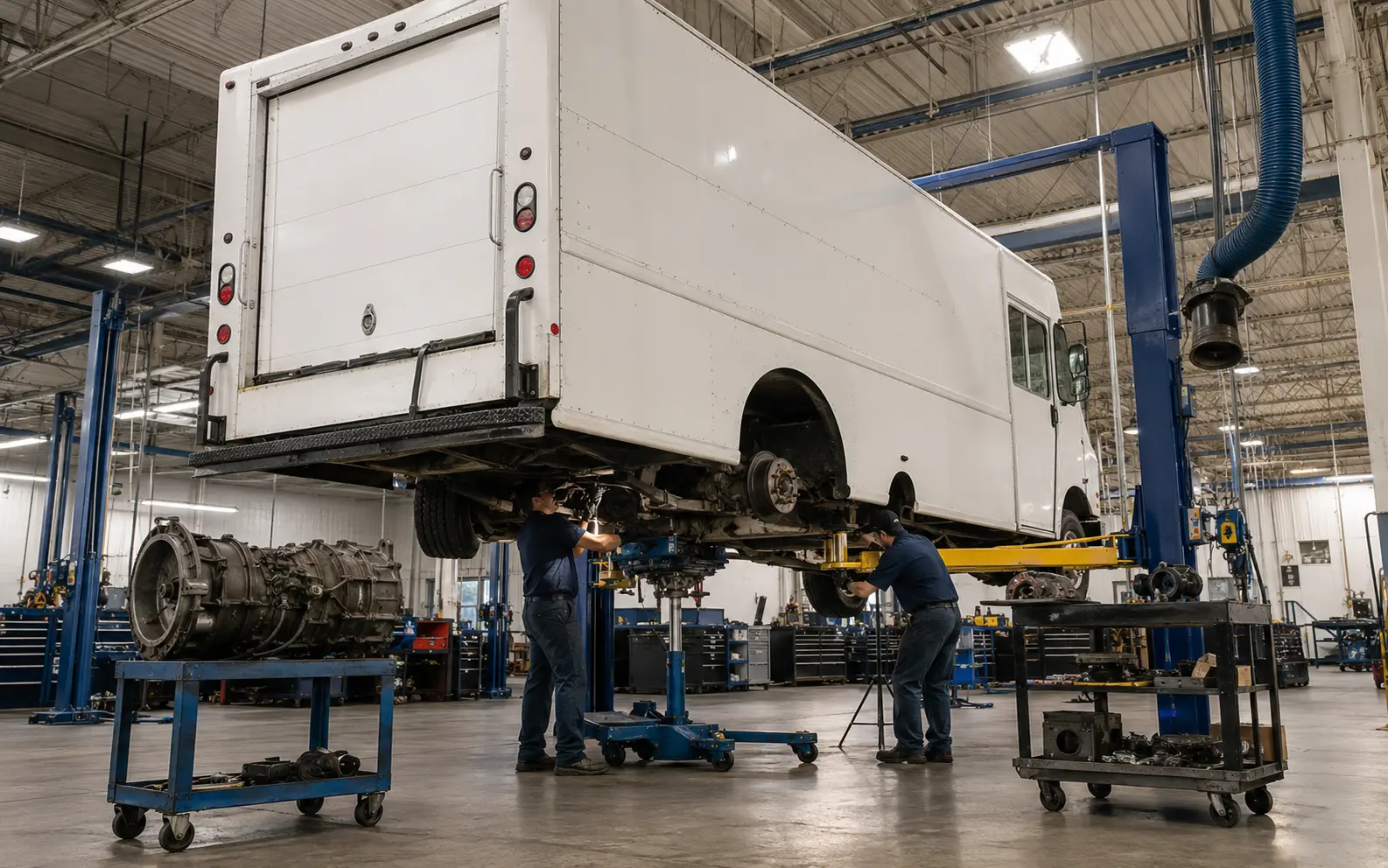
Recognize repairs that require lifts, specialized testing, major disassembly, controlled shop conditions, or broader technical capabilities.
What Is Shop Service?
Shop service moves the vehicle to a fixed commercial repair facility equipped for more extensive inspection, diagnosis, and repair.
A shop may provide:
- Vehicle lifts
- Heavy diagnostic equipment
- Alignment systems
- Welding and fabrication equipment
- Brake and suspension tools
- Fluid-handling systems
- Secure parts storage
- Indoor work areas
- Multiple technicians
- Specialized powertrain capabilities
- Controlled conditions for complex repairs
Shop service becomes necessary when the work cannot be completed safely, efficiently, or correctly in the field.
Shop Service Is Usually Best When:
- The vehicle requires a lift.
- The repair involves major component removal.
- Specialized testing or calibration equipment is needed.
- The diagnosis remains uncertain after an initial evaluation.
- The vehicle requires extensive brake, suspension, engine, transmission, or emissions work.
- Structural repairs or fabrication are required.
- The job will take multiple technicians or several days.
- Weather or site conditions prevent safe field work.
- The vehicle needs secure indoor storage.
- A large number of parts may be required.
- The repair may expand substantially after disassembly.
Sending the wrong repair to mobile service can add an unnecessary service call before the vehicle is eventually towed. Sending every minor repair to a shop, however, creates avoidable transportation and queue time.
Evaluate Repair Complexity
Level 1: Routine Maintenance
Examples include:
- Oil and filter service
- Lubrication
- Fluid checks
- Battery testing
- Lighting inspection
- Tire-pressure service
- Scheduled fleet inspections
- Minor adjustments
These services are strong candidates for planned mobile fleet service, particularly when multiple vehicles are located at the same terminal.
Level 2: Defined Minor Repair
Examples may include:
- Battery replacement
- Starter or charging-system diagnosis
- Lamp or electrical repairs
- Belt or hose replacement
- Minor fluid leaks
- Door hardware
- Step or grab-handle repairs
- Sensor replacement
- Basic no-start diagnosis
Mobile service may be appropriate when the defect has been accurately described and the technician can bring the likely parts and tools.
Level 3: Advanced Diagnosis
Examples include:
- Intermittent electrical faults
- Repeated warning lights
- Engine-performance problems
- Diesel emissions faults
- Network communication issues
- Parasitic battery drains
- Unexplained overheating
A mobile technician may be able to identify the problem, but the vehicle may still require shop service for complete testing or repair.
Level 4: Major Repair
Examples include:
- Engine replacement
- Transmission replacement
- Major internal engine work
- Differential repair
- Extensive suspension work
- Structural or collision repair
- Alignment correction
- Major emissions-system repair
- Repairs requiring extensive disassembly
These jobs generally belong in a properly equipped commercial repair facility.